AI is not replacing jobs whole. It is unbundling them into tasks, then automating the tasks it does well. For leaders, the question has changed from "Will AI take this role?" to "Which parts of this role will still create value, and how do we build people who stay ahead?"
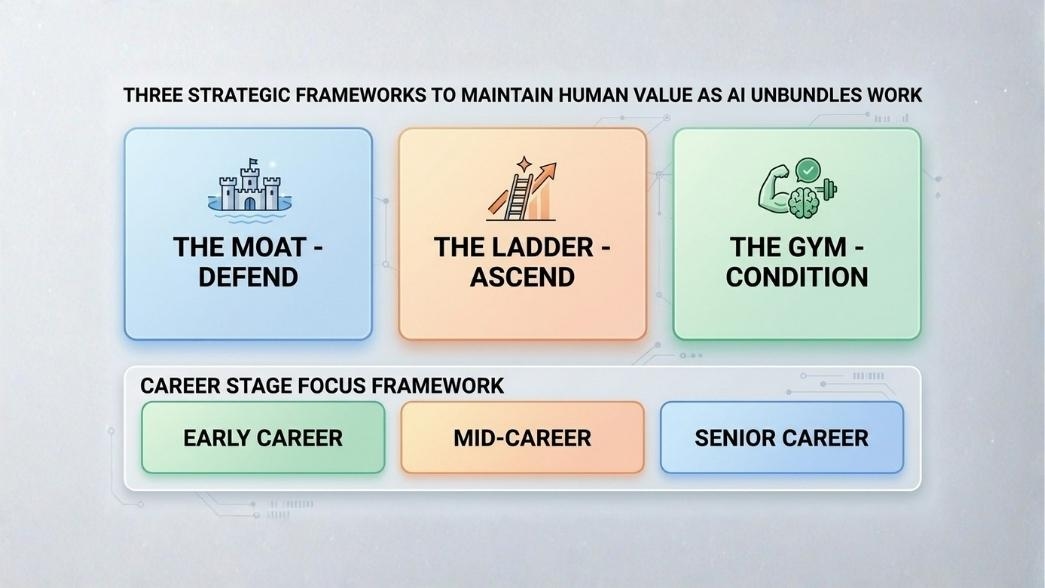
INSEAD Professor Phanish Puranam offers a simple, practical answer through three strategies: the Moat, the Ladder and the Gym.

Moat, Ladder, Gym · three strategies and the focus by career stage
The Moat and the Ladder depend on forecasting AI's path; the Gym does not, which is why every career stage keeps some of it.
1. The Moat: defend your human premium
The idea: Double down on what algorithms cannot replicate.
How it works: Break your work into distinct tasks. Hand repetitive, data-heavy and formulaic tasks to AI. Protect and sharpen the work that needs deep judgement, emotional intelligence, physical presence and nuanced context.
In practice: A physician lets AI read scans and transcribe notes, then spends the time saved on patient counselling. A lawyer automates contract reviews to focus on high-stakes negotiation and client trust. A CMO automates reporting and first-draft content, and protects brand judgement, stakeholder influence and decisions under uncertainty.
The risk: A moat depends on predicting what AI will not master. If technology advances faster than expected, the moat narrows.
2. The Ladder: ascend to new capabilities
The idea: Climb deliberately toward the skills the market will need next.
How it works: Look 1–3 years ahead, identify the high-value capabilities emerging, and acquire them before they become mainstream. Examples include AI orchestration, directing agentic workflows, and responsible AI governance.
In practice: A copywriter becomes a director of multi-modal generative AI workflows. A business analyst moves from writing manual queries to interpreting and challenging autonomous analytics agents.
The risk: Like the Moat, the Ladder depends on an accurate forecast. Spend two years climbing toward a skill that gets automated, and the return on that effort falls sharply.
3. The Gym: condition for whatever comes next
The idea: Train the foundational meta-skills that let you climb any ladder.
How it works: No one can reliably predict the tools or roles of the next five to ten years. The most durable safeguard is learning how to learn, through cognitive adaptability, critical thinking, first-principles reasoning, rapid prototyping and comfort with ambiguity.
In practice: Regularly pick up unfamiliar tools simply to practice fast onboarding. Break new problems down to their fundamentals, whatever the domain.
Why it matters: The Gym is the only strategy that does not depend on a forecast. It makes it forecast proof.
A portfolio, weighted by career stage
Everyone needs all three. The right balance shifts with career stage.

What does this means for leaders
- Run task audits, not job audits. Map your organisation's work at task level to see clearly what to automate, what to augment and what to protect.
- Treat capability as a portfolio. Shift learning budgets from one-off training toward a balanced mix of Moat, Ladder and Gym investments, and measure the reskilling ROI.
- Make learning velocity a leadership metric. Value how fast people adapt alongside what they already know.
- Lead from the Gym yourself. Senior leaders who rely only on their Moat are exposed. The most credible signal to an organisation is a leadership team visibly learning in public.
The bottom line: The winners of the AI era will not be the organisations that predict the future best. They will be the ones whose people can adapt fastest to whatever future arrives.